
The subject of English encompasses several courses including reading lessons, grammar, dictation, and recitation. This section provides videos explaining some of these courses, as well as immersion videos so you can watch lessons in action.
Grammar
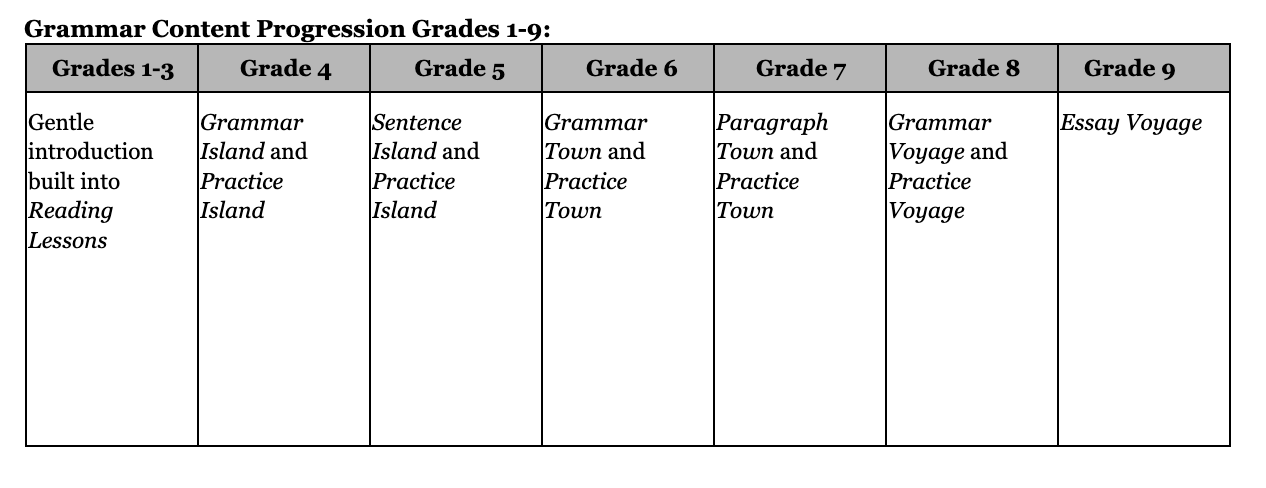
Knowledge of grammar is necessary for good oral and written communication, but it is also very abstract. Introducing it slowly gives students time to be immersed in language as a whole before analyzing its parts. Young students in the Alveary get a gentle introduction to grammar through our Reading Lessons. Starting in Grade 4, they study the subject in-depth and systematically. The grammar courses we recommend by Michael Clay Thompson used in Grades 4-9 include parsing, and we like how the whole series relies heavily on ideas, rather than mere memorization. Each book has a set of accompanying practice exercises, and students are encouraged to observe examples of grammatical concepts in their school books and in daily life. Thompson also does an excellent job showing students how to apply grammar to composition, an approach which supports the transition from the younger years to middle- and high-school level writing. As Thompson confirms in the introduction to one of his courses, “Writing is, in part, grammar applied.”
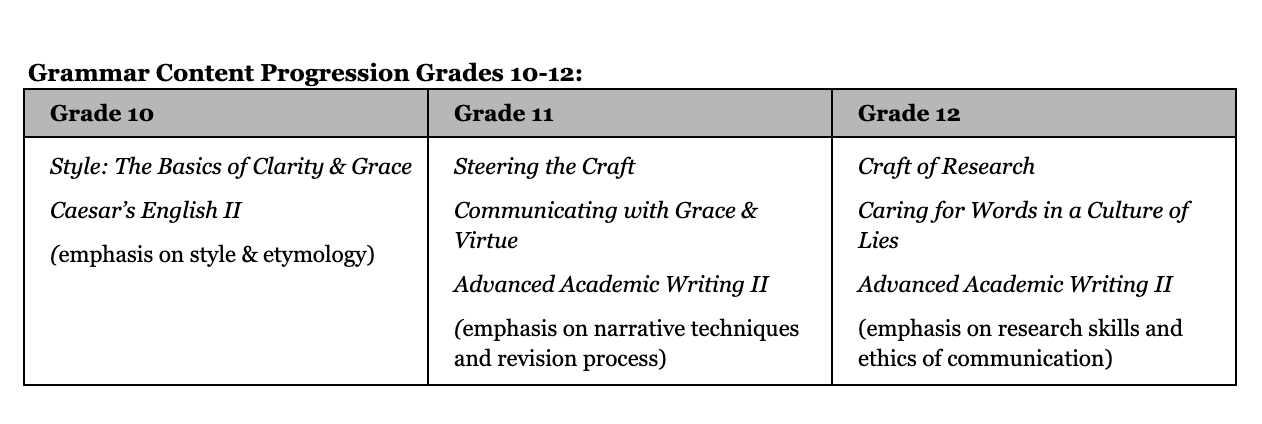
In Grades 10-12, the study of grammar merges with the formal study of composition. Books such as Style: The Basics of Clarity and Grace, Quentin Schultze’s Communicating with Grace and Virtue, and others help students apply and extend their knowledge of grammar to see its implications for how to communicate with others with clarity, wisdom, and creativity.
Dictation (22 min)
There is some confusion in the Mason community surrounding dictation and writing, because, while formal lessons do not start until Grade 4, there is much groundwork to be laid in Grades 1-3. Students are gradually scaffolded from visualizing letters to words to short sentences, so that when they get to Grade 4 they will be ready to prepare a longer passage. Older students who missed this important step may begin dictation with single words, sentences, and/or paragraphs before being asked to prepare whole pages.
As students get older and dictation becomes a habit, the teacher can give more of the responsibility for preparation to the student. If students make many mistakes, assess whether the problem lies in the passage being too difficult or too long or if the student still needs some teacher support. Once students can consistently study 2-3 pages in a variety of texts (with one paragraph dictated) without making more than a couple of mistakes, you can cease doing Dictation.
In this video Dr. Jen Spencer discusses Mason's method of dictation and how to implement it with your students.
Writing
“Writing” (not to be confused with “Composition”) is a term that Mason used to describe penmanship and copywork. It is practiced every day. Writing skills are essential for the exercises that are required of students in Language Study and Composition.
Penmanship
Penmanship instruction looks a bit different in the Mason model. Rather than completing a whole page in a handwriting workbook, students concentrate on doing one or two things well. For young students, a chalkboard is used instead of pencil and paper. This makes it easier to erase any errant stroke or letter until it is correct. Once students improve their motor control and move to paper, they focus on one or two letters per day. Mason recommends practicing until the student can produce about six very good copies of a particular letter. The habit of visualization is implemented here. Instead of the eye constantly moving back and forth between the model and the chalkboard or paper, students should look carefully at the letter until they can see it in their minds’ eye, and thenwrite it from memory. The Penny Gardner penmanship book we use contains blank lined paper in the back that can be used for practice until your student has mastered the letters. At that point, you can transition to primary paper, which you can find on the Supply List. The Gardner book also has words that can be used as copywork and dictation once your student masters the letters. We do make copywork and dictation suggestions from the term’s books in the lesson plans, but there may be some weeks when you need to pull from Gardner’s selections. Be sure to use the same process of visualization of whole words when you get to that point. The book is structured to work through lower-case letters one at a time, but when you get to the upper-case letters you will need to work through those the same way even though practice exercises are not included.
If you would like to use a different model from the one we recommend, there are a few things to keep in mind. The penmanship model should be chosen based on beauty, but it needs not to be overly ornate. We like the italic model for both print and cursive, but this decision is one of personal preference. The only caution from Mason is to stay away from models that are overly simplistic because all the letters look largely the same.

Copywork & Commonplace Books
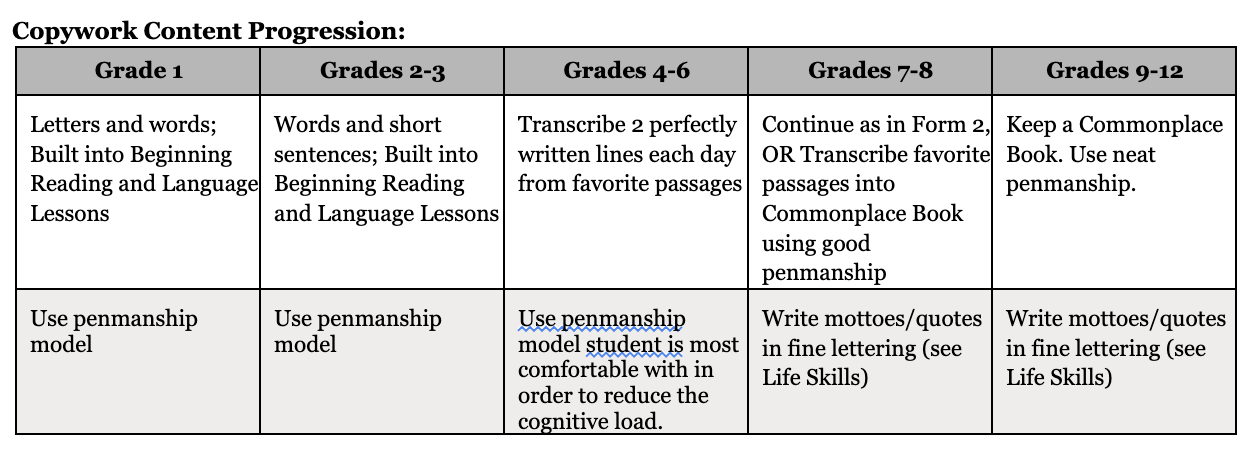
For students in Grades 1-3, copywork is built into the Alveary Reading Lessons. These lessons guide students first to visualize letters, then words, then short sentences, and write each from memory. It is very important that students learn to visualize from the very beginning. They should never move their eyes back and forth between the model and their papers, copying letter-by-letter. Instead, the whole word or short phrase should be visualized until it can be written from memory.
In Grades 4-6, copywork gets its own time slot in the morning schedule. Copywork should consist of about two lines per day from passages that the teacher or student has chosen from the term’s reading or from the Copywork suggestions Alveary provides. If the student does not have favorite passages, the teacher can assign something and model how to choose interesting passages until the student starts to do this independently. Keep in mind that there is no need to force students to finish copying a whole poem, song, or scene, since they can grow weary of it before they get to the end.
Sometime between Grade 7 and Grade 9 most students will be ready to move to keeping a Commonplace Book. A Commonplace Book is a lined journal that the students keep as a collection of quotes and passages that seize their imagination. It is the same as copywork, with the exception that there is no required amount to copy per day, and the focus is more on the ideas and the literary style than on practicing penmanship. Students become ready to move to the Commonplace Book once penmanship is mastered and once they begin to express delight in specific passages.
The teacher should keep a Commonplace Book and model how to choose passages to copy. (“Wow. I really liked the way the author said that. I want to think about it some more. Let me mark it with a sticky note in my book, and I’ll copy it later in my Commonplace Book.”) Eventually, the student will begin to notice passages that are stirring, resonant, or well-written and may start to ask for sticky notes, too. When that happens, you know the student is ready to have his/her own Commonplace Book. We recommend allowing the student to choose a nice lined journal for this special book which they may want to keep for years.
Other students may never show any particular interest in keeping a Commonplace Book. Once they reach Grade 9, however, they should be encouraged to read with sticky notes at hand to give them an opportunity to mark favorite passages. If the time comes for copywork and the student has not chosen anything, the teacher can assign a poem, part of a scene from Shakespeare, or something else from the day’s reading, which the student can copy two lines at a time each day.
Mason also had students copy mottoes using fine lettering, which they learn in handicrafts (see Life Skills). Mottoes are short phrases or sentences that attempt to capture one’s guiding beliefs or ideals, such as "High thinking, plain living." Students may also enjoy looking for maxims and proverbs or quotations from favorite authors or historical figures in a book of quotations or online to write out in their best penmanship (in their Commonplace Book or another notebook). Motto writing is generally reserved as a Sunday activity.
Commonplace Book (4 min)
Composition
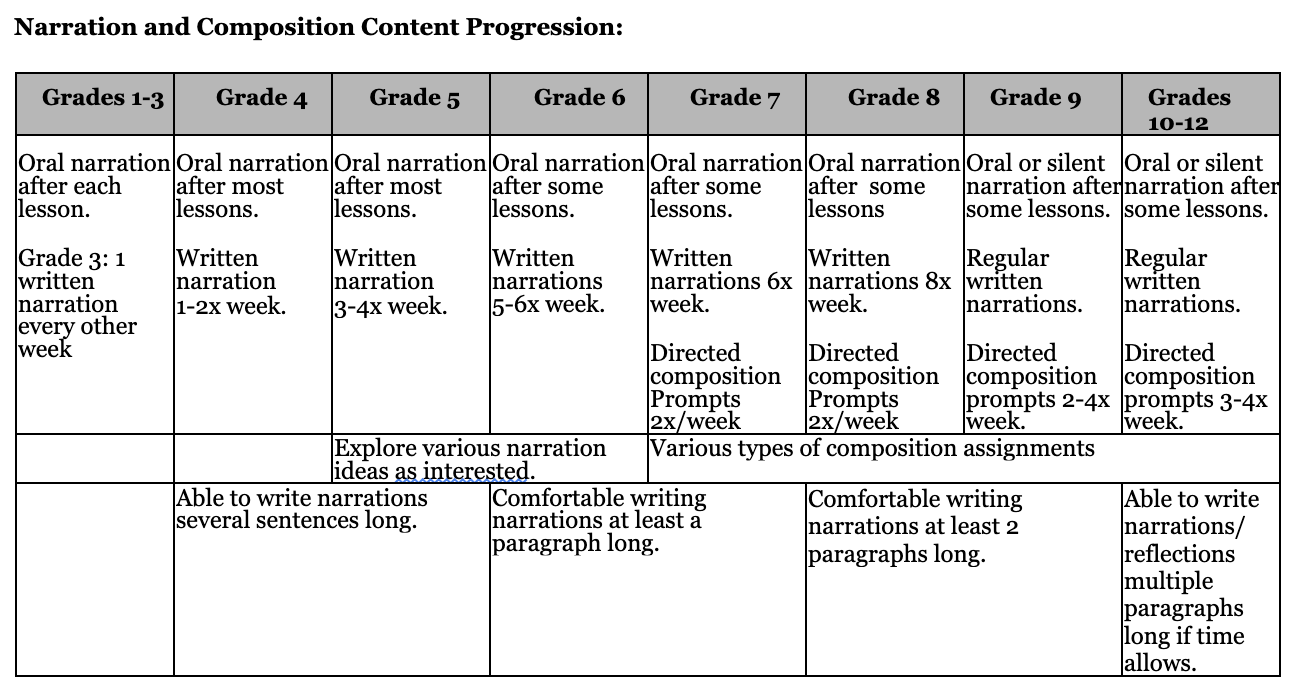
Writing skills begin orally through the consistent use of narration. Narration helps the student develop all the skills they will need for writing while allowing time for motor control, letter formation, and spelling to become automated. (See Cognitive Load webinar for further explanation.) Mason’s model helps students develop the underlying skills that contribute to good writing through such methods as copywork, dictation, and grammar study; but development in composition is achieved primarily by focusing on the ideas and style. This begins with the study and narration of good examples. During Grades 4-6, students apply these skills to the communication of ideas as they produce a gently increasing number of written narrations each week. As students progress, narrations become longer and students experiment with a variety of ways to retell their readings. All these skills together provide the scaffolding which will support the practice of original, effective, persuasive, and creative writing which is the narrower use of the term “Composition.”
Then in Grade 7 students take a separate course called Composition which includes more formal writing assignments beyond what is accomplished during a lesson in a written narration. Throughout Grades 7-12, writing prompts often draw from subject areas across the curriculum to allow students to reflect further on ideas in their studies and focus on specific writing skills at the same time. Both narrations and compositions build students’ skills in writing. The focus in narrations is on building written fluency by "telling back" the reading in written/typed form (and students are free to experiment with various ways to do this or not as interested). The focus in composition assignments is to give students accountability and structure to practice specific skills in or types of writing.
Composition Assignments
Mason assigned several advanced books on composition and grammar to students entering Grades 9-12 (Forms 4-6) in order to help them see and hear how words work and experiment with different types of writing. Exercises and exam questions from the PNEU reveal a variety of assignments including précis writing, paraphrasing, essay writing, character sketches, letter writing, verse writing, and scene writing. Lessons in literature and/or composition also introduced students to concepts such as symbolism, the sound and rhythm of words, etymology, and more. Writing a few decades after Mason, Flannery O’Connor describes what also reflects Mason’s approach to composition as well when she writes that composition lessons should help students understand the “limits and possibilities of words and the respect due them” (“Nature and Aim of Fiction” in Mystery and Manners, p.83).
Following Mason’s lead within our 21st century context, Alveary composition assignments help students explore a wide variety of written forms and literary concepts including story and scene writing, poetry writing, summary, paraphrasing, persuasive and argumentative writing, letter writing, narrative techniques, point of view, descriptive writing and dialogue, genre analysis, logic, editing, revision, and research. The goal is for students not only to graduate with academic writing skills sufficient to enter college, but to delight in words and have the tools to love and serve others (a form of hospitality) through their reading and writing.
The focused composition assignments between Grades 7 and 12 begin by building on familiar types of writing and then gradually increase in complexity. Sometimes, a composition prompt assigns a specific type of "telling back" (for example, retelling a reading as a poem, which a student may or may not have already experimented with of their own accord in their narrations). Additionally, compositions move beyond narration and variations of "telling back" to assignments which ask students to direct their attention to specific ideas within or across their readings (such as comparing and contrasting characters or texts). Or the assignment will ask the student to write a type of reflection which previously only occurred orally during the discussion after the reading and narrating components of their lessons. Many assignments pull from books and ideas across the curriculum to give students writing topics which they have already interacted with in some way. The additional repetition also increases the likelihood that the content will make it into the student’s long-term memory, allowing them to focus on the writing skill at hand, and develop their own voice.
Lessons in editing and revision also begin in Grade 7 and continue throughout high school, and starting in Grade 9 composition assignments merge with grammar assignments (as mentioned above) to help students understand the writing process more globally and consider aspects of style, editing, revision, research, and the ethics of communication.
Recitation
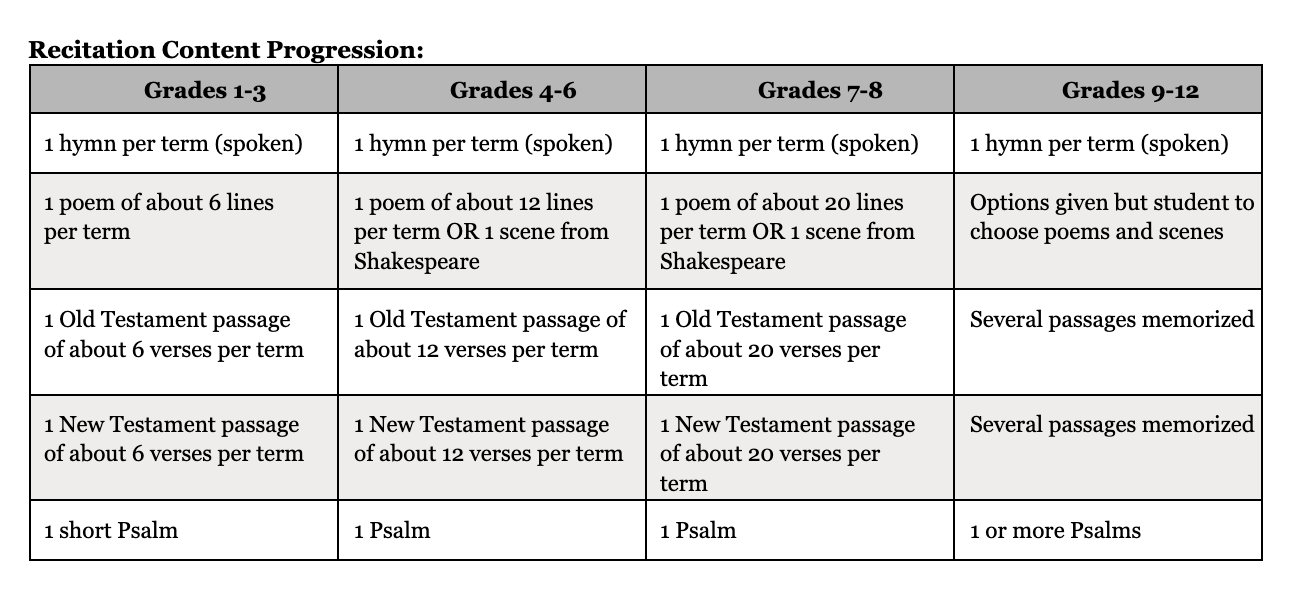
Students have opportunities to practice clear speaking and elocution across the curriculum. One practice that should be encouraged is for students to read some of their assigned lessons aloud each week, either to the parent or teacher, a sibling or partner, or to themselves. Another is recitation, an oral interpretation of a passage that has either been memorized or practiced as a beautiful reading. The ratio of how much should be memorized versus how much should be read aloud will depend on the student’s natural proclivity towards memorization. Those for whom memorization comes easily may be able to recite all of their selections from memory, while those who really struggle can focus on memorizing just one piece and reading the rest. Most students will fall somewhere in between, but practicing with an eye towards memorization is recommended. Just like Mason’s assertion that Picture Study will furnish the mind with a gallery of beauty that can be enjoyed forever, the same is true of the storing of beautiful and meaningful passages.
Whether read or memorized, recitations should be beautiful. They should reflect each student’s comprehension and interpretation of the passage. Therefore, students will need to practice well beyond the point at which the piece can be simply read or remembered. The primary focus for recitation is on the ideas of the passage or poem, rather than on a “performance” during which the student is the center of attention.
Mason says in her volumes that practice for recitation should not be drudgery for the student. She encourages teachers to go over the passage as a whole until it is ready to be recited. Upper grades with much longer recitations may need to divide the piece into meaningful parts. She paints a lovely picture of a mother and daughter practicing together as the mother brushes the child’s hair. Aside from this, she refers readers to Arthur Burrell, who called recitation “the children’s art.”
Notes from Arthur Burrell
The purpose of recitation is right in the title of Burrell’s book on recitation: Clear Speaking and Good Reading. It provides us with some guidelines for recitation. Here is a brief synopsis:
- Nothing should be assigned that the student does not comprehend. Make sure to read the passage and have the student narrate it before beginning. Make sure he/she knows the meanings of all words.
- Since we are after the student’s personal interpretation, do not provide a model for him/her to mimic. The more the student practices and the more familiar the passage becomes, the more style will naturally emerge.
- Choral practice (or having several students practice in unison) is discouraged, because it leads to a monotonous tone and rhythm. Each student should have the opportunity to stamp his/her own personality and interpretation onto the recitation.
- Overacting and hand gestures are distracting and should be discouraged. The goal is for the student to be able to sink him/herself beneath the author’s voice. (Note: Some teachers tell us that relying on gestures at first can help some students remember more. Once the passage is learned, however, those gestures should be put away.)
What is Recitation? (5 min)
Recitation Lesson (6 min)
Reflection
Respond to the following in the comments or in your journal:
1) What new ideas did you glean from the videos that you would like to implement with your students?
2) Do you have a greater understanding of how ideas are part of recitation?
3) Explain the steps that are part of a dictation lesson.
4) What are you wondering?
In Mason's Own Words
Recitation-Read Home Education, Part 5, Section 7 in its original text and/or in modern English.
Dictation-Read Home Education, Part 5, Section 12 in its original text and/or in modern English.
Further Reading
"Recitation: The Children's Art" by Arthur Burrell
The Elements of Style by William Strunk and E.B. White (Parent resource that can be used for helping your students with editing).
40 Favorite Hymns of the Christian Faith: A Closer Look at their Spiritual and Poetic Meaning by Leland Ryken (There are many other books in this series. Although the singing of hymns should be commended, Ryken discusses the importance of slowing down to read and think about the meaning of hymns. He provides poetic and theological insight into many of the great hymns. This book can be used as a way to understand the hymns better as you discuss them with your student during recitation.)
