
"It is a great thing to possess a pageant of history in the background of one’s thoughts." (Volume 6, p.178)
Charlotte Mason believed that “Next in order to religious knowledge, history is the pivot upon which our curriculum turns” (Vol. 6, 273). Reading living books from a particular period of history each year allows students to make connections across subjects through a historical lens, thus furnishing their imaginations with what Mason called a “mental pageant of history.”
History is not about knowing dates and events or even developing a rough outline of a particular century. It is about building a relationship with the past. The best ways to do that is through living books that immerse students in the time period. These can be engaging non-fiction books, biographies and historical fiction. It is important for students to develop historical consciousness which is a mindset that changes how they see both themselves and the world. Part of an historical consciousness is realizing two important truths: The past was different from our present and our lives are poorer when we cut ourselves off from that. Mason says, "The present becomes enriched for us with the wealth of all that has gone before" (Philosophy of Education, p.279).
History Cycles
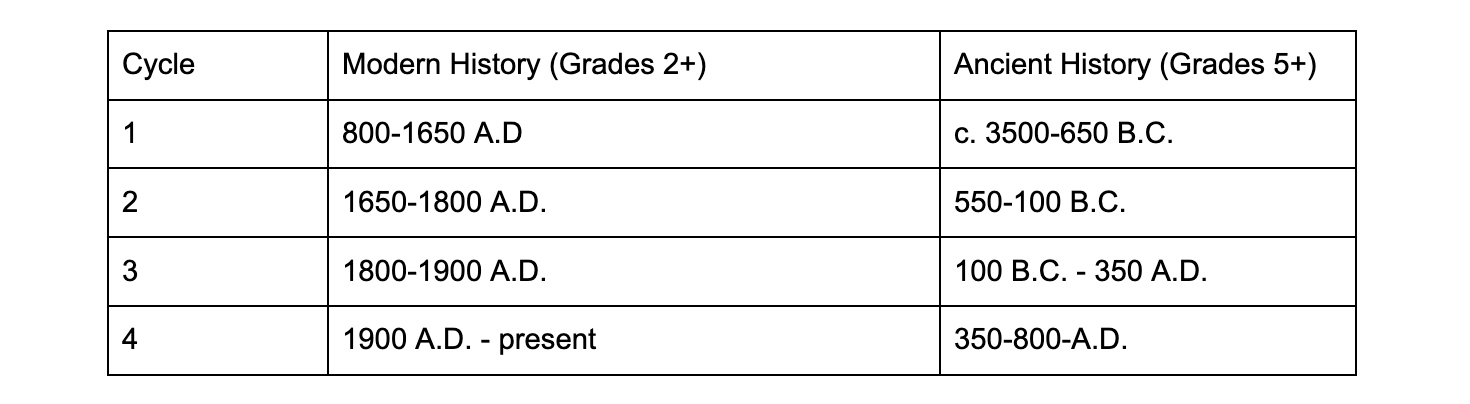
Following Mason’s guidance in Home Education that the “early history of a nation is far better fitted than its later records for the study of children” (Vol. 1, 281-2), all students in Grade 1 study Pre-Columbian culture. From Grade 2 onward, the content of the Alveary curriculum is organized around four cycles of both modern and ancient history. All students study the same history cycle at the same time. This makes combining and placing students simple.
Also, across the curriculum, literature, art, music, architecture, geography, recitation, Shakespeare, and dance are developed each year to complement the current history period being studied. This approach gives the Alveary extraordinary cohesiveness.
The 2026-27 school year will focus on Cycle 3. (Only one cycle is available per year; all members should work in that cycle.) Many other subjects, either wholly or in part, correlate with the time period being studied, so that each year’s course of study is truly cohesive. The following year (2027-2028), all grades will be in Cycle 4, which means that a different set of books will be used (though some carry over from one year to the next).
Course Progression
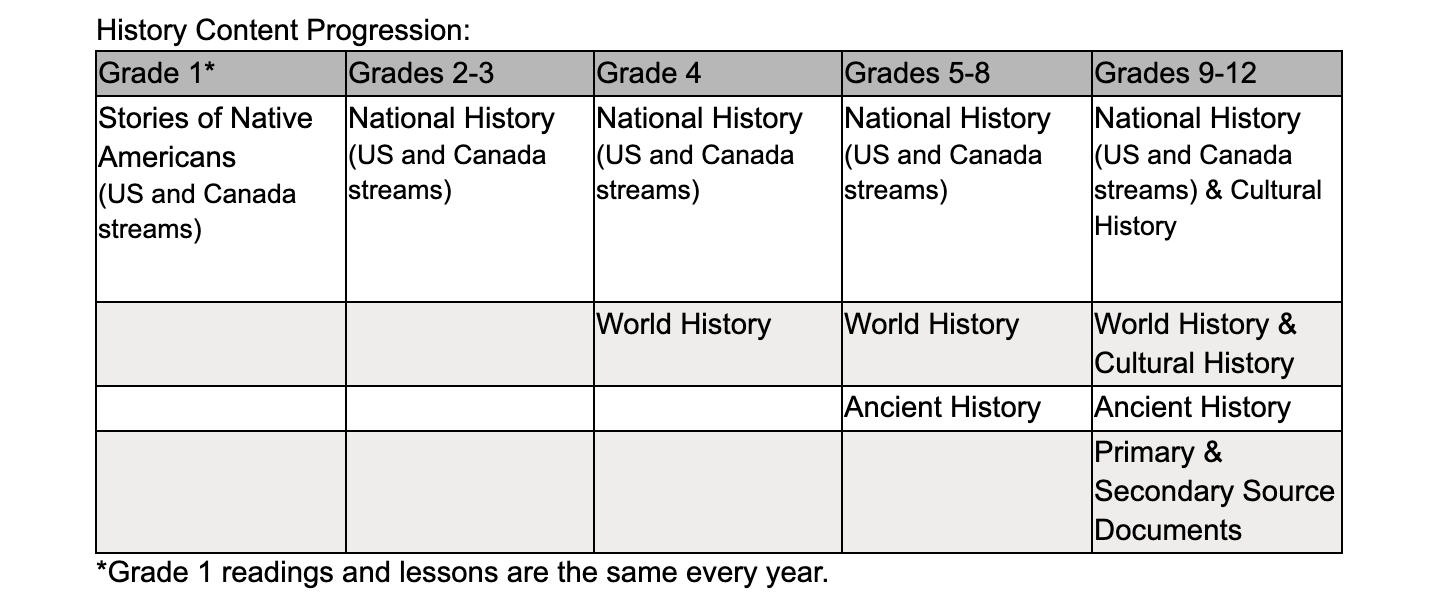
A student who follows the Alveary from Grades 1-12 will proceed through each history cycle three times. However, as the student matures, new strands of history are added and are studied concurrently. High school students use source documentation to support subject matter.
Timelines, History Charts, and Books of Centuries
Resource: Timelines and History Charts
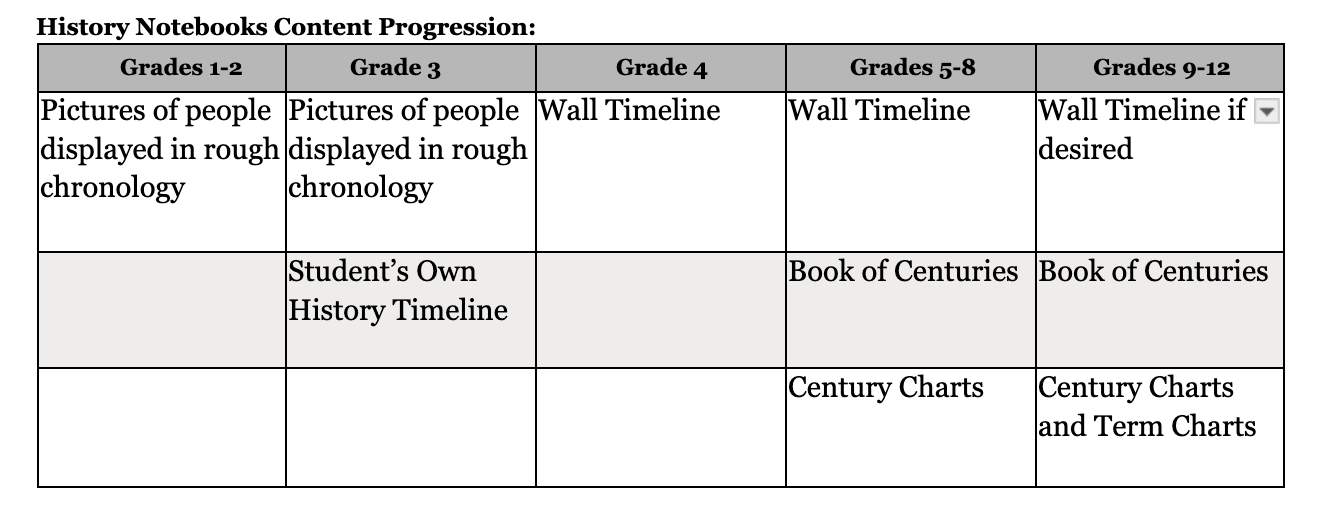
Mason suggested several tools to help students make connections and keep up with what was happening in different places at the same time. The keeping of timelines, charts, and notebooks is a helpful part of the history curriculum. Please note that the student should choose what to record. Some students may want to keep them handy during all lessons in order to record things immediately; others may prefer to set aside time once per week to record major characters or events. We provide lists of important dates in the lesson plans for Grades 1-8. High School students may wish to keep a running list of entries they wish to make. Alternatively, they could mark places in their books with sticky notes so they can come back to them later.
These practices grow along with the student, and as students take more ownership for their own education, they use timelines, charts, and notebooks as a place to process what they are learning. As they select what information they want to include, they are actively forming their own relationships to God, other people, and the universe.
Book of Centuries (9 min)
Captain Ideas for the Study of History (27 min)
What is history and what are the big ideas we want our students to ponder as they study history? Dr. Shannon Whiteside answers these questions as she encourages us to see history as a living subject and not a set of static facts.
Aims and Goals for the Study of History (10 min)
In this video, history professor Dr. Tracy McKenzie shares his insights about the knowledge and skills he would desire for students to have before entering college. As you will see, his thoughts line up with the way Mason views the study of history.
Teaching History to Elementary Students (with Tracy McKenzie) (2 min)
Why Should We Study Different Perspectives in History? (3 min)
Thoughts About Revisionist History (8 min)
Should We Focus on an Overview of History or Specific Events? (5 min)
Human History with Dr. Jen Spencer (26 min)
Reflection
Respond to the following in the comments or in your journal:
1) How would you define history? How was history taught to you when you were in school? Does your past experience as a student learning history influence how you now teach your own students?
2) What did you take away from the videos that changed how you view history and how you will teach history?
3) What are some tangible ways that you can foster historical thinking and consciousness in your students at any age?
4) What questions do you still have?
In Mason’s Own Words
"To sum up, to know as much as they may about even one short period, is far better for the children than to know the 'outlines' of all history. And in the second place, children are quite able to take in intelligent ideas in intelligent language, and should by no means be excluded from the best that is written on the period they are about" (Vol 1, p.287).
"History shows you its personages, clothed as they were clothed, moving, looking, speaking, as they looked, moved, and spoke, engaged in serious matters or in pleasures; and, the longer you look at any one person, the more clearly he stands out until at last he may become more real to you than the people who live in your own home. [. . .] Once Intellect admits us into the realms of History, we live in a great and stirring world, full of entertainment and sometimes of regret; and at last we begin to understand that we, too, are making History, and that we are all part of the whole; that the people who went before us were all very like ourselves, or else we should not be able to understand them. If some of them were worse than we, and in some things their times were worse than ours, yet we make acquaintance with many who were noble and great, and our hearts beat with a desire to be like them. That helps us to understand our own times. We see that we, too, live in a great age and a great country, in which there is plenty of room for heroes; and if these should be heroes in a quiet way, whom the world never hears of, that does not make much real difference. No one was ever the least heroic or good but an immense number of people were the better for it; indeed, it has been said that the whole world is the better for every dutiful life, and will be so until the end of time. (Vol. 4, p.37-38).
"He who reads history in this way, not to pass examinations, nor to obtain culture, nor even for his own pleasure (delightful as such reading is), but because he knows it to be his duty to his country to have some intelligent knowledge of the past, of other lands as well as of his own, must add solid worth to the nation that owns him. It is something to prepare for the uses of the State a just, liberal, and enlightened patriotism in the breast of a single citizen (Vol. 4, p.75).
"We can not live sanely unless we know that other peoples are as we are with a difference, that their history is as ours, with a difference, that they too have been represented by their poets and their artists, that they too have their literature and their national life" (Vol. 6, p.178).
"I do not hesitate to say that the whole of a child's instruction should be conveyed through the best literary medium available. His history books should be written with the lucidity, concentration, personal conviction, directness, and admirable simplicity which characterizes a work of literary calibre" (Vol. 6, p. 339).
Further Reading
“How to Make a History Chart” by A. G. Biggar. Parents’ Review, 1910, p.547-549.
“The Book of Centuries and How to Keep One” by Gertrude. M. Bernau. Parents’ Review, 1928, p.224-235.
“The Teaching of History” (in two parts) by H. A. Nesbitt. Parents Review, 1898, p.240-246, 302-307.
“History: History and Fiction” by H. B. Parents Review 1894/5, p.255-259
Shannon Whiteside’s Alveary Weekly article about History spines
The Living Page: Keeping Notebooks with Charlotte Mason by Laurie Bestvater
A Little Book for New Historians by Robert Tracy McKenzie
Priests of History by Sarah Irving-Stonebraker
